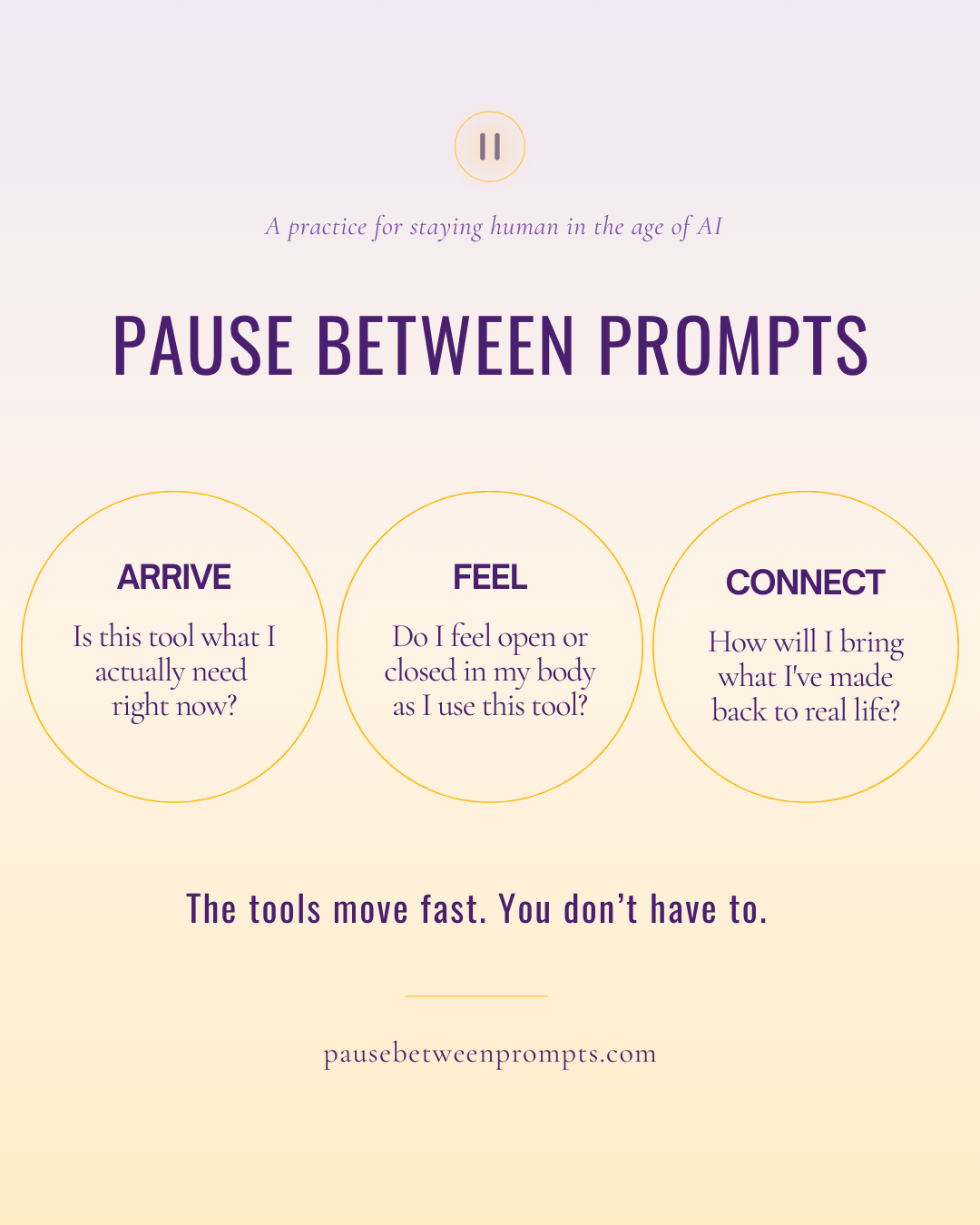
Before you finalize, pause. Ask yourself:
How will I bring this — and myself — back to real life?
AI doesn't know your context, your people, what actually matters in your life. If you never pause to connect what it creates back to your real world, you slowly hand over your judgment to the tools.
You send a message that sounded thoughtful in the chat but is ice cold in someone's inbox. You submit work that technically answers the question but misses everything that was said between the lines. You make a decision that made perfect sense on screen but falls apart the moment someone asks you why.
That's the gap. And only your discernment can close it.
AI can simulate dialogue. It can write the copy. And as these tools become more agentic, they can even execute tasks on your behalf. But they cannot feel the impact. They don't know what's at stake. And they won't live with the consequences. You will. The people around you will. Which is why your human relationships matter more than any output.
Yes, those relationships can be messy. They require discomfort, listening, repair. But that messiness is what makes them irreplaceable.
And as AI floods the internet with content, what you'll trust most is what you can actually touch off the screen: the people you're accountable to, the communities you belong to, the natural world around you, the delightful serendipities no tool could generate.
This pause brings you back to that. The tools can assist. But you decide what crosses into your real life. And where no tool gets to go.
The tool generates a report. It looks professional and sounds right so you quickly hit send. Later, your colleague messages: "Did you actually read this?" The tool missed the context and your colleague had to redo it to meet the deadline.
Before you send the report, you read it carefully. Does this actually connect to what was asked for? What do you know about this project that the tool doesn't? Does it sound like a human wrote it? You catch a few things and revise before you send.
AI gives you advice about a situation and you immediately follow it. Things blow up because you completely misread the dynamics.
You share the advice with a trusted friend. They push back on the advice in a few places, and encourage you to sit with it for a bit. You cool off and realize you can go about this differently.
AI helps you finish your work faster. You use the extra time to take on more projects, respond to more emails, generate more ideas. You're getting so much done. You haven't stopped moving in days.
You notice you have time back. Instead of filling it with more work, you use it for something that actually feels nourishing — you call a friend, you take a walk, you read something just for pleasure.
You have an important decision to make. You work it through with AI, evaluating the pros and cons and mapping the path forward. You announce your plan and people are hurt that you didn't include them in a decision that affects them too.
You ask yourself: who else does this affect? You bring it to the people involved. They point out considerations you hadn't thought of. The conversation shifts how you see the whole situation. The decision you make together is different than what you would have chosen alone.
Your conversations with AI feel easier, more understanding, more fulfilling than your human relationships. It always gets you. It never judges. You find yourself choosing to talk to AI instead of the people in your life.
You realize the ease comes from lack of reciprocity, lack of risk. And over time, that feels less satisfying. You start showing up to a community space where people expect to see you, where your presence actually matters to others. It's not perfect, but it feels better somehow.
- What do I know about this situation from actually living it? Is that knowledge informing what I'm doing here?
- What assumptions am I making here? Would checking with someone help me see more clearly?
- Who in my actual life is affected by this? Have I included them in a way that feels right?
- What in my life exists entirely outside of screens, and when did I last give it real attention?
- Do end-of-week reflections: Set aside 15 minutes at the end of each week. Ask yourself: What did I do this week in my actual life, with actual people? What do I love about my real life? What needs tending?
- Anchor yourself somewhere: Choose one place — a weekly dinner, religious community, volunteer role, creative group, whatever! — where your absence would be noticed. Those are the people who'll still be there as the tools keep changing and life keeps happening.